Instant Lead Response
Fit Kaki — Singapore's first boutique strength training studio for seniors
The Problem
A small team of trainers can't answer inquiries while they're coaching. After-hours and weekend leads go cold — by the time someone responds on Monday morning, the prospect has moved on. Every missed message is a missed client.
The AI Approach — Conversational AI
Not a chatbot. Chatbots follow scripts and break when users go off-track. This problem needed conversational AI — a system that understands intent, manages multi-turn dialogue, handles objections, and takes real action (booking sessions, updating calendars). The distinction matters when a prospect asks something unexpected at 11pm on a Saturday.
What We Deployed
AI agents on WhatsApp and the business phone line. Answers questions about classes and pricing, handles common objections, and books trial sessions directly into the calendar. Runs around the clock with no human intervention required.
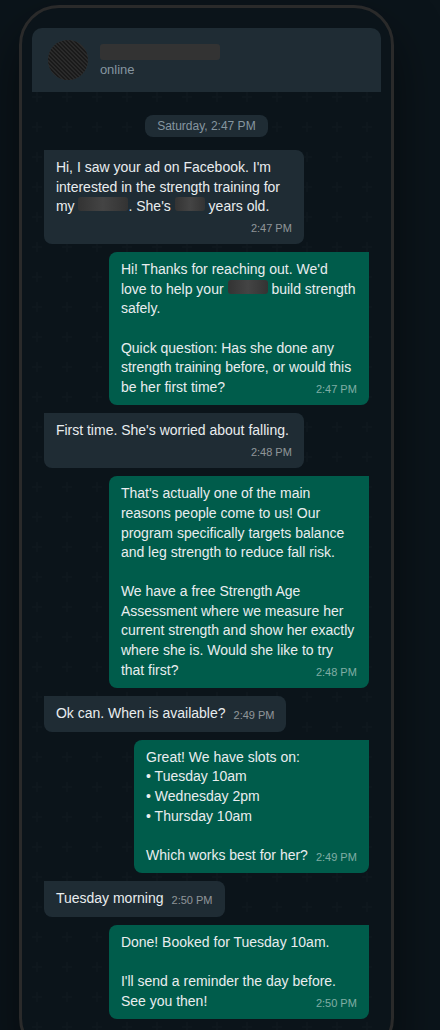
Actual conversation, Saturday 2:47 PM. Personal details redacted.
The Outcome
Every inquiry gets a response. Trial bookings happen while the team coaches. After-hours and weekend messages — previously lost — now convert at the same rate as business-hours inquiries. Trainers stay focused on clients and never check their phone mid-session.
The Saturday Afternoon Lead
Razif, Fit Kaki's founder, was still getting used to the AI. For weeks after deployment, he monitored every conversation, watching what came in, checking how the AI responded, building trust in the system.
Then one Monday morning, he noticed something: a client was scheduled for Tuesday. He checked the messages. The inquiry had come in Saturday afternoon. A prospect had messaged, asked about trials, and the AI had booked her directly into the calendar. Razif hadn't even seen it.
The next day, the prospect showed up. She became a paying client.
"I was still watching every message for weeks. I needed to trust the system. Then one Monday, I saw a client booked for Tuesday. The inquiry came in Saturday afternoon. I never even saw it. The AI answered her questions and put her on the calendar. She showed up, and she became a client. That's when it clicked: we would have lost her completely."
Razif Yusoff, Founder, Fit Kaki
Strength Age Assessment
Fit Kaki — Objective physical assessment for seniors
The Problem
Trainer assessments were subjective — they varied between trainers, couldn't be standardized, and were difficult to track over time. There was no metric a senior could take home to show their family or share with a doctor. Progress was a feeling, not a number.
The AI Approach — Computer Vision
We chose pose estimation — a Computer Vision technique that detects body landmarks from photos. The critical design decision: all processing happens on-device. No personal images leave the tablet. For elderly clients in a care context, privacy isn't optional.
What We Deployed
A tablet-based assessment tool. Trainers photograph the senior from front and side. The AI detects 33 body landmarks, analyses posture, and combines this with grip strength data benchmarked against a 2.4-million-person international dataset to produce a single metric: Strength Age. The entire assessment takes under 10 seconds.
The Outcome
Subjective assessments replaced with an objective, repeatable score. Every senior now has a number they can track across sessions — and a professional PDF report they can share with family or their doctor. Trainers who used to spend time filling out forms now focus entirely on coaching.
Yield Forecasting
Raih AI — Palm oil yield prediction for plantation management
The Problem
Palm oil plantation managers guess at future yields. Millions in revenue depend on accurate forecasts, but biological lag — 18 to 36 months between weather events and their effect on harvest — makes prediction extraordinarily complex. By the time you see the impact, the cause happened two years ago.
The AI Approach — Machine Learning Ensemble
This problem demands structured data prediction — not generative AI. We engineered dozens of domain-specific features, tested multiple model architectures, and built an ensemble that combines the strengths of different algorithms. A single model can't capture the complexity of a crop that takes 3 years from flower initiation to harvest. The ensemble approach — where each model contributes what it does best — consistently outperforms any individual algorithm. That's why we chose it over trendier alternatives.
What We Deployed
Data inputs: Historical production records across hundreds of plantation blocks, weather data (including climate indices and water balance), agronomy practices, and material application records — spanning multiple years of operations.
Biological lag modelling: Five distinct lag phases modelled, from flower initiation through to harvest. The model captures how weather and management conditions years before harvest affect today's yield.
Ensemble approach: Multiple model types combined, each contributing different strengths — one captures non-linear patterns, another handles feature interactions, a third provides stability. The ensemble outperforms any single model.
The Outcome
A working forecasting model built on real operational data, validated against actual production records. Plantation managers gain the ability to forecast yield months ahead using data instead of intuition — turning a guessing game into a planning tool.
Plantation Monitoring
PalmVision — Satellite-based plantation health intelligence
The Problem
Plantation managers can't physically inspect thousands of hectares. Problems — pest outbreaks, nutrient deficiency, water stress — go unnoticed until yield drops. By then, the damage is done and the cost is measured in tonnes of lost production.
The AI Approach — Satellite Computer Vision
We analyse satellite imagery using vegetation indices — NDVI for canopy health and NDMI for moisture stress — to detect anomalies from space. Combined with geospatial analysis, we achieve field-level precision: the system knows not just that something is wrong, but exactly where on the plantation it's happening.
What We Deployed
Monitoring platform: Interactive maps with polygon-based field boundaries, management dashboard, and user authentication.
Satellite processing: Multi-spectral imagery analysed for vegetation health (NDVI) and moisture stress (NDMI) at field-level precision.
Spatial pinpointing: Geospatial database maps anomalies to individual field blocks — not just "there's a problem" but exactly where on the plantation it is.
The Outcome
Platform deployed and operational. Plantation managers can now monitor field health remotely instead of relying on physical inspections across thousands of hectares. Ground teams receive targeted directions — specific blocks, specific issues — instead of general sweeps.
Opportunity Intelligence
Art Radar — AI-powered opportunity discovery for creative professionals
The Problem
Creative professionals build careers through awards, exhibitions, grants, and residencies — but opportunities are scattered across 75+ sources with no central database. Hours are spent searching instead of creating. The best opportunities are often found by luck, not strategy.
The AI Approach — Data Aggregation + AI Scoring
The system continuously monitors sources, aggregates opportunities, and scores each against custom professional criteria. This is multi-factor relevance scoring — not simple keyword matching. The AI weighs style match, medium compatibility, cultural relevance, career-building potential, and deadline proximity to surface the opportunities that actually matter for a specific professional profile.
What We Deployed
Source network: 75+ verified sources — galleries, grant bodies, award organizations, curator feeds, and residency programs — continuously scanned and aggregated into a single searchable database.
AI scoring engine: Five-factor relevance scoring: style match, medium compatibility, cultural relevance, career-building potential, and deadline proximity. Each opportunity scored against a specific professional profile.
Dashboard: Mobile-friendly interface for quick daily checks. Filtered views by relevance, deadline, and opportunity type.
The Outcome
Hours of weekly manual searching replaced by a single dashboard check. The system has already surfaced opportunities that would have been missed entirely — exhibition calls buried in curator newsletters, grants from regional arts councils, deadline-sensitive residency programs posted on sources no one checks manually.
Compliance Assessment
Komplyze — Regulatory gap analysis for Singapore SMEs
The Problem
Most Singapore SMEs don't know where they're exposed to regulatory fines. Finding out traditionally means hiring a consultant, waiting days, and paying for the privilege of learning you have gaps. So most businesses skip it entirely and hope for the best — until an audit happens.
The AI Approach — Regulatory Intelligence
A proper gap assessment means cross-referencing a business's operations against thousands of regulatory requirements across 7 areas. That volume is what makes it expensive when done by hand. AI handles the cross-referencing — making it possible to offer a genuine, detailed assessment for free. The assessment is the starting point. What businesses do with the findings is where expert engagement begins.
What We Deployed
Free assessment platform: Deployed at komplyze.com — any Singapore business can run a compliance gap assessment at no cost.
Coverage: 7 compliance areas — PDPA, workplace safety, employment law, anti-money laundering, cybersecurity, environmental regulations, and industry-specific requirements.
Output: Personalized gap report identifying specific regulatory exposure areas.
The Outcome
Businesses that run the assessment consistently discover exposure they didn't know existed — not theoretical risks, but specific requirements they were failing to meet. The barrier to knowing where you stand went from "hire a consultant" to "visit a website."